Secure, scalable, and sustainable RFID solutions
RFID Technology for Enterprises
RFID (Radio Frequency Identification) is the technology that powers today’s contactless world. From hotel key cards and EV charge cards to logistics tracking and access control, RFID technology enables secure, touch-free data exchange between objects and systems.
At Oomph, we design and manufacture sustainable RFID solutions for enterprise clients. Our products combine high-performance chip technology with eco-friendly materials, helping organisations improve efficiency, traceability, and sustainability across every touchpoint.
How RFID works
An RFID system has three main components: a tag, a reader, and an antenna. RFID operates across three main frequency bands, each suited to different environments and applications:
Low Frequency (LF) – short-range identification, such as staff IDs or asset tracking.
High Frequency (HF) – used for secure access control, ticketing, and payment cards.
Ultra-High Frequency (UHF) – long-range identification for logistics, vehicle tracking, and supply-chain management.
Our technical team can help determine the right frequency, chip type, and encoding method for your RFID project.
RFID applications
Access and Mobility
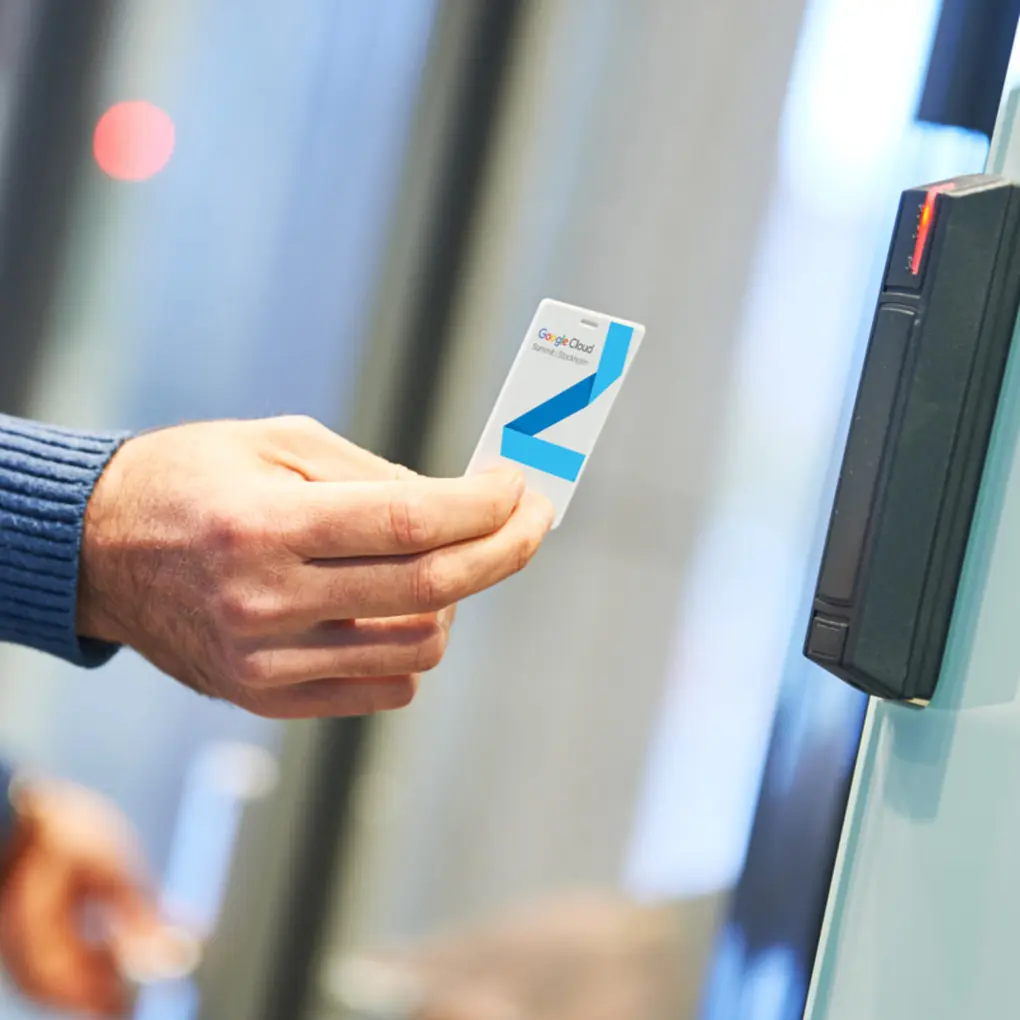
RFID access cards enable secure entry and controlled movement across sites.
Typical applications include: hotel key cards, vehicle access, EV charge cards, visitor passes, and toll management systems.
Retail and Payments
RFID cards and labels enable fast, reliable payment and loyalty systems.
Applications include: contactless payment cards, loyalty and membership cards, and smart retail tagging.
Healthcare and Supply Chain
In regulated environments, RFID ensures accurate tracking and traceability.
Applications include: patient identification, pharmaceutical tracking, and medical asset management.
Events and Experiences
RFID simplifies attendee management and brand activation.
Applications include: access credentials, cashless payment wristbands, and interactive event passes.
Supporting your RFID journey
Every organisation uses RFID differently, which is why a tailored approach matters. At Oomph, we don’t just supply products; we work as an extension of your team to design, refine and deliver the right solution for your system, scale and sustainability goals.
Our process brings together technical consultation, precise chip and frequency matching, and expert material engineering to ensure your RFID products perform exactly as required. Whether you’re integrating RFID for access control, logistics, or customer engagement, our specialists will help you specify, test and deploy with confidence.
We manage global fulfilment and hold strategic stock across regions, ensuring fast delivery for both large-scale rollouts and smaller pilot runs. From prototype to full production, our focus is on consistency, quality and long-term partnership.
Services
- Global printing and personalisation
- Product design
- Prototyping
- RFID consultation
- Production management
- Established global supply chain
Looking for a proven RFID technology partner to support development?
Tell us more about your project. We can work with you to develop a custom RFID solution that enables your technology to scale. With thousands of RFID deployments to our credit, we are able to provide personalised, secure data encoding and customisation.
Sustainability and material innovation
We’re committed to creating the most sustainable RFID solution on the market.
Our Pulper Zero® technology represents the next step in eco-engineered RFID design. Combining responsibly sourced wood fibre with printed silver conductive ink to form a 100% recyclable RFID inlay. This Greener RFID solution eliminate plastic and metal while maintaining full technical performance.
Switch to the enterprise quality of innovative contactless technology.
Here's how brilliant brands are working with us
Insights from our blog
Get your hands on expert advice and read inspiring stories about materials, technology and sustainability.


FAQs - RFID technology
What is NFC?
What is RFID?
RFID or Radio Frequency Identification enables one-way wireless communication, typically between an unpowered RFID tag and a powered RFID reader. RFID operates across low frequency (LF), high frequency (HF) and ultra-high frequency (UHF) frequency bands and offers scanning distances from 10cm to 100m.
RFID is generally used for airport baggage handling, road toll collection and asset tracking as it does not require a direct line of sight to the reader and can be scanned from much further distances.
How does NFC work?
How does RFID work?
In much the same way as NFC although there is a difference in that Radio Frequency Identification (RFID) tags can be active rather than passive which helps to increase the scan strength and read distance. RFID uses electromagnetic fields to identify and track tags attached to objects automatically. The RFID system consists of a small radio transponder, a radio receiver, and a transmitter. When an electromagnetic interrogation pulse is triggered from a nearby RFID reader device, the tag transmits digital data, usually an inventory identification number, back to the reader. This number may be used to track inventory goods.
There are two types of RFID tags:
- Passive tags are powered by energy from the RFID reader’s interrogating radio waves
- Active tags are powered by a battery and thus can be read at a greater range from the RFID reader, up to hundreds of metres
"Very good experience with the technology team! Highly recommend."